
The widespread use of generative answer engines is the largest shift in user behaviour of at least the last 15 years, when now-mainstay social media platforms allowed people to get information directly from the source. I don’t consider it a coincidence that, now our collective ideas of ‘authority’ and ‘truth’ are eroding thanks to said platforms, AI search is gaining traction.
It’s reasonable to consider that people are turning to AI as a ‘middleman’ thanks to its conversational reasoning and eagerness to agree with users. And with 44% of people preferring AI as their dominant search method in the relatively early years of AI search, there seems to be no time to waste in optimising your content for these engines. But first, it’s essential to realise how user behaviour is changing through the use of these engines.
How answer engines are changing search behaviour
Traditional search engine user behaviour is built on individual searches, with the algorithm in a constant state of refinement to assess available content and serve the ‘right’ answer to you. While rankings extend for many pages, three-quarters of people don’t look past page 1, meaning the user experience is centred around bouncing from link to link until you find an answer that suffices. The experience could be visualised as this:
![Flowchart showing "Search" linking with arrows to "Page Link 1," "Page Link 2," and "Page Link [x]."](/_next/image?url=https%3A%2F%2Fa.storyblok.com%2Ff%2F296269%2F751x680%2F24241310ec%2Fsearch-engine.jpg&w=3840&q=75)
Generative engines are a much different environment:
It’s captive: You are served one chat stream in a dedicated window that speaks directly to you, rather than a string of ad links, a featured snippet box, and then organic website links.
It’s interactive: LLMs are built to sustain multiple searches about a topic into a conversation string, meaning you can act upon the information you gather without leaving the platform.
It’s proactive: More often than not, the next step is suggested to you as the LLM is constantly guessing your overall objective.
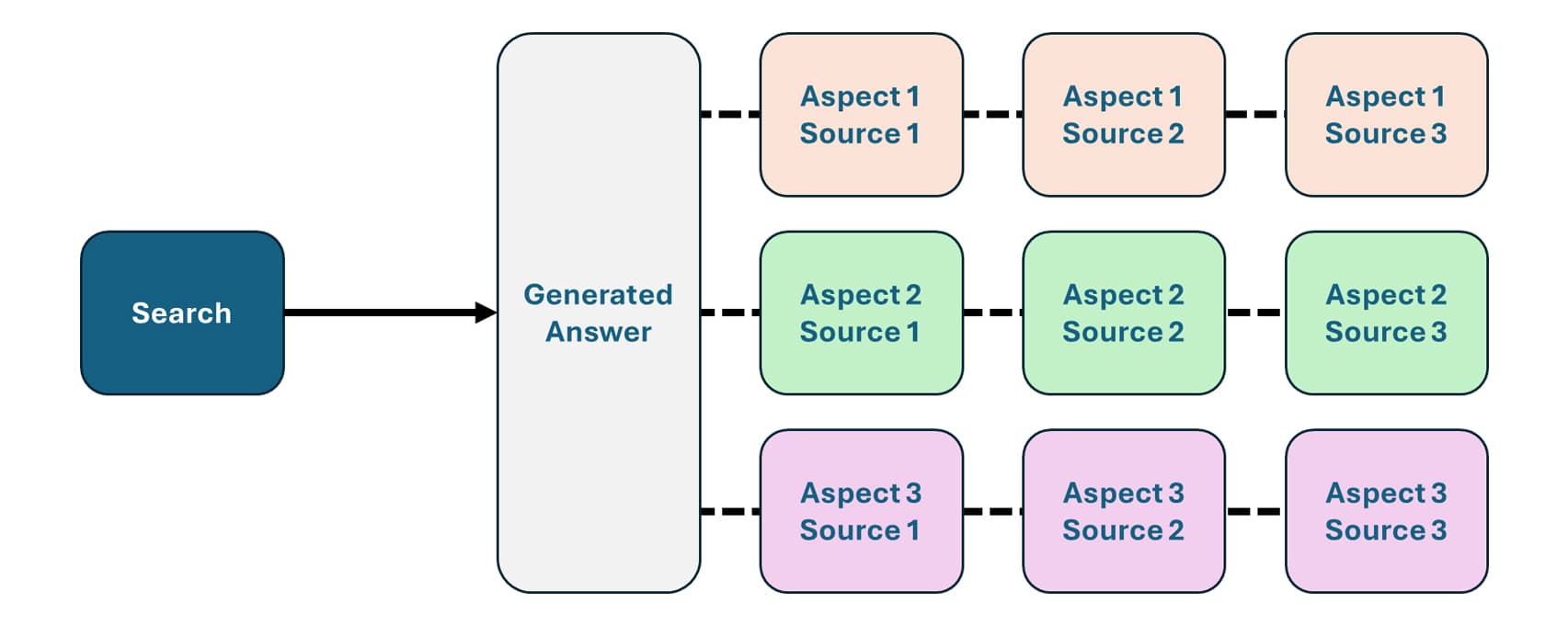
So already, the searcher’s behaviour is much different. Rather than being overwhelmed by options (links) which they might bounce between in the hunt for the ‘right’ one, they go to an answer engine with a topic or task in mind that they will either research or complete in the engine itself.
If we compare real-world searches, we can see the differences from both engines’ perspectives and see how the ‘proactivity’ element comes into play.
Comparison: Searching for Elvis Presley
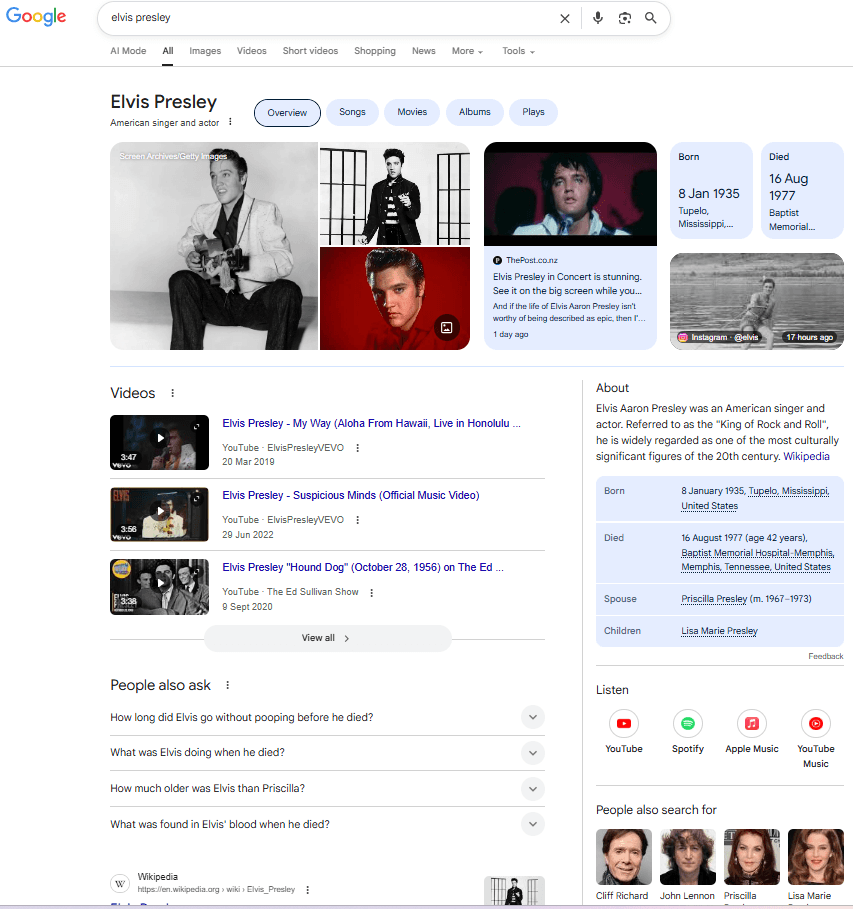
Let’s say I’ve just heard someone mention Elvis Presley for the first time, and I want to know more about them. A regular Google will give me no end of different media to learn through (including some other musicians, just in case I got the root search wrong to begin with):
Meanwhile, a search in Google’s own AI mode is much more concentrated:
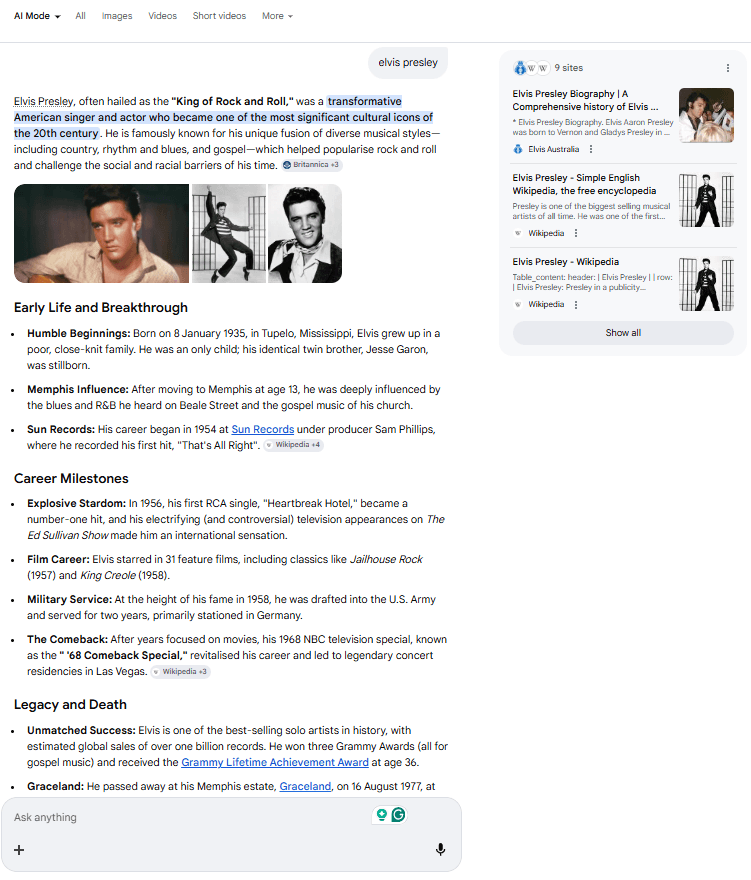
When we consider GEO, you’re not aiming for a higher page ranking, but instead to appear in a synthesised answer based on the user’s personal history. This is a much more ‘captive’ user, and breaking them out of the engine to take action is incredibly difficult for basic (informational) searches. Thankfully, generative engines are always asking for the next action. In our Elvis Presley example, Gemini offered to serve more information:
“Would you like to know more about his biggest hits, his film career, or his life at Graceland?”
With our psychology of generative answer searches established, we can now focus on how to optimise for them.
Optimising for answer engines
Strategy: Create content for every step of the user journey
It seems increasingly clear to me that customers will do as much research as possible in the confines of the answer engine, as it is psychologically clear of any ‘salesmanship’ (at least until ads are fully rolled out). To increase your chances of being cited and becoming part of the engine’s proactive suggestions, you need to clearly map individual pieces of content to each part of your customer’s buying journey.
This isn’t a revelatory idea, but it does require a shift in content production perspective towards more specific customer personas. No consideration is too small, and no potential customer search should be dismissed. That means handling how you produce and store your information logically so that generative engine bots can crawl your website efficiently and gather the information they need to serve you as a reliable source of its information.
Let’s take a travel agency as an example, which wants to sell more holidays to Spain. Your customer could be a new retiree, a backpacking gap year student, or anyone in between. Although you’re selling the same end product, the content produced for the retirees will be markedly different to the content produced for students.
The engine knows which user it’s dealing with, but do you have content specifically for them?
Social: Create regular short-form content
Although we’re more than a quarter of the way through the 21st century, I still see companies trotting out the same social media tactics of socials, charity donations, and employee anniversaries. These are totally fine coming from individuals, but company accounts cannot and will not ever be considered ‘human’. The harsh truth is that generative engines look to social media for the most up-to-date content, and it won’t care that Leonard in Accounts is looking forward to exciting new challenges in this, his 14th year at your company.
Answer engines want what social media algorithms (and people, for that matter) want: a constant influx of new information. Engines are always trying to use the most recent data possible. While many have trained datasets up to a specific date and then scrape for newer information based on user prompts/tasks, I don’t expect we’re far away from engines that stay ever-updated. You must post consistently (3-5 posts a week) on your social media channels with informative content that answer engines can read and serve to searchers.
This doesn’t mean you need to give your marketing team an aneurysm. Social media content is getting ever shorter, with platforms building either bespoke areas for short-form content (e.g. YouTube Shorts) or outright preferring shorter content in the video elements of their algorithms (e.g. LinkedIn). Take any piece of content and break it down as small as you can.
I also cannot stress enough that generative engines will not care for production quality. Yes, you need a baseline of quality (clear audio recording) but you do not need flashy intros and DSLR cameras for 1080p video. You need a short video with one piece of interesting, informative, or actionable piece of information. The shorter it is, the faster it is to record and the simpler it is to edit.
Ecosystem: Increase your visibility through other platforms
Answer engines want to know the information they’re gathering is correct, and getting your content seen as ‘correct’ requires engaging in the wider ecosystem of your given industry.
Attend and speak at industry events. Appear as a guest on a podcast. Show how you and your company fit in the raft of information and potential sources the generative engines can pull from. Thankfully, the need for publications and accounts to create the same short-form content I mentioned earlier means that they should snap your hand off if you offer to contribute something for them.
This element is something of a holdover from the SEO best practices playbook. We all know the importance of appearing authoritative and trustworthy. Many companies take these qualities and only apply them to their brand’s tone of voice, equating authority with ‘amount of detail’ and trustworthiness solely with aspects like customer reviews. And while answer engines like a company that’s been well-reviewed, increasing the number of people talking about you is a clear way for engines to be pointed towards you more frequently.
But will answer engines drive traffic to my website?
The good news is yes, and the bad news is your traditional ‘organic’ search traffic probably won’t recover to levels you’re familiar with. It’s a logical case of quality over quantity. Although marketing departments across the world are still being measured by GA4 graphs going up and to the right, AI-based traffic should be completely different from broad ‘organic’ traffic.
As we’ve already discussed, searches are more likely to stay and conduct research in the confines of their answer engine of choice. They’ll only visit your site, or contact you directly, once that becomes the next logical step in their customer journey. That means they’ve conducted information research, price comparisons, ran example scenarios, and done anything else they can imagine except commit to a purchase. But when they come to you, they’ll be in a much more confident mindset to buy.
Continue your SEO practices
It isn’t exciting, and it isn’t attention-grabbing, but the fact remains that the backbone of GEO is remarkably similar to SEO. Generative answer engines, just like Google, want authoritative websites that are easy to navigate and content that is easy to understand. Do not listen to evangelists who claim GEO has put an end to SEO.
GEO is a markedly different experience that demands specific efforts for optimisation. I hope you can use the information above to establish your company’s presence in the new landscape of LLMs and generative answer engines. But just as ‘vibe coding’ developers eventually bump up against the limitations of a rush towards results, you do not need to upend your broad website optimisation strategy.

Content Marketing Manager
James Story is a content marketing manager with over a decade of experience in SEO, B2B marketing, and social media content creation. He is also Co-Owner and Studio Manager of Rabble Studio, a creative co-working space in the heart of Cardiff Bay.
What is a headless website? A practical guide for teams who’ve outgrown their CMS.